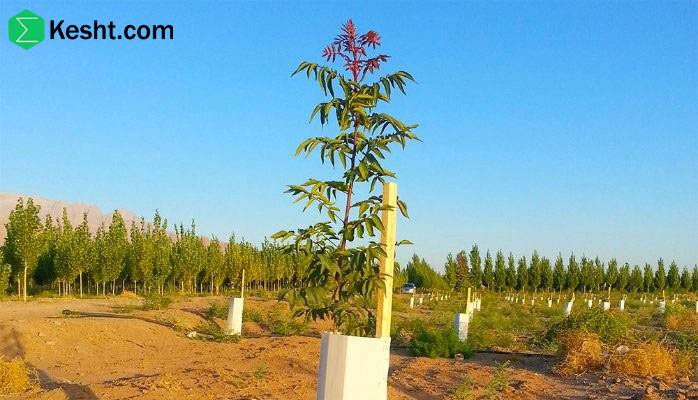
What’s the difference between hybrid and seed-grown pistachio seedlings?
- Hybrid (e.g., UCB‑1) = a controlled cross between two known parents 🧬; more uniform, typically more vigorous, and often more stable against some soilborne diseases (like Verticillium). Downsides: higher cost and the need to buy from a reputable nursery.
- Seed-grown = produced from diverse, naturally pollinated seed 🌱; cheaper and adaptable, but more heterogeneous. If not grafted, sex and nut quality are unknown—so not recommended for commercial orchards.
Definitions—so we don’t mix terms
- Seed-grown (seedling): a plant raised from seed (it can serve as a rootstock and later be grafted, or remain ungrafted).
- Hybrid: a plant with specified, intentionally crossed parents (in pistachio this usually means a “hybrid rootstock” such as UCB‑1, not a nut cultivar). These are often produced from seed of the controlled cross; “clonal hybrids” also exist and are even more uniform.
- Grafted: a plant whose scion (e.g., Akbari/Ahmad Aghaei) is grafted onto a rootstock (seedling or hybrid). For commercial orchards, grafting is essential.
If you are interested, it is recommended that you read the following article / article title:
How to boost the environmental resilience of hybrid pistachio seedlings
https://ekesht.com/en/blog/how-to-boost-the-environmental-resilience-of-hybrid-pistachio-seedlings
Practical comparison
| Feature | Hybrid (e.g., UCB‑1) | Seedling rootstock (beneh/atlantica/…) | Ungrafted seedling (P. vera) |
| Definition | Controlled cross of two species/cultivars (often atlantica × integerrima) | Natural seed of a single species (beneh/atlantica/mutica/integerrima…) | P. vera seed without a named, grafted scion |
| Growth uniformity | High to fairly high (very high if clonal) | Medium to low (large variation among trees) | Highly variable |
| Verticillium tolerance | Usually better | Depends on species: beneh/atlantica = medium to good; integerrima = weaker | Uncertain |
| Cold tolerance | Medium (better than integerrima, weaker than beneh/atlantica) | Beneh/atlantica: good; integerrima: weak | Uncertain |
| Salinity/SAR tolerance | Usually medium to good (management-dependent) | Species-dependent: atlantica/beneh = medium; integerrima = relatively good | Uncertain |
| Early growth/vigor | Strong and uniform | From slow (beneh) to moderate | Unpredictable/wide spread |
| Time to bearing (with the same scion) | Slightly earlier due to stronger growth | Typically normal | Unpredictable |
| Hidden risks | Mislabeling/fraud in the nursery market | High heterogeneity between trees | Risk of male trees; unknown nut quality |
| Cost/availability | Higher; needs a trusted nursery | Cheaper and widely available | Cheap but unsuitable for commercial orchards |
| Best suited for | Sites with soil disease history, replant blocks, uniform production | Cold/high‑elevation areas (beneh/atlantica), calcareous/low‑water sites | Non‑commercial trials or as rootstocks for later grafting |
Decision notes
- If you face Verticillium the UCB‑1 hybrid rootstock is usually the safer bet./replant risk:
- If your climate is cold or prone to late frosts: seedling rootstocks of beneh/atlantica are generally more stable.
- If water salinity/SAR runs higher: UCB‑1 or integerrima can help, but irrigation/leaching management is decisive.
- For commercial orchards: always buy certified, grafted plants; “ungrafted seedling” is uneconomical because sex and nut quality are unknown.
If you are interested, it is recommended that you read the following article / article title:
Methods for producing hybrid pistachio seedlings
https://ekesht.com/en/blog/methods-for-producing-hybrid-pistachio-seedlings
Frequently asked questions
- Does “hybrid” mean “clone”? Not necessarily. Many UCB‑1s are seed‑propagated hybrids (uniform, but not identical). Clonal versions exist and are even more uniform.
- Does “hybrid” mean it will produce excellent nuts without grafting? No. In pistachio, “hybrid” usually refers to the rootstock; you still need a named scion for quality and marketability.
Buying guide for peace of mind
- Documentation: scion/rootstock ID plus phytosanitary/quarantine certificates.
- For UCB‑1: verify the provenance of the controlled‑cross seed and the nursery’s credibility.
- Plant specs: 1–2 years old; healthy, non‑circling roots; sturdy collar; properly placed graft union; trunk whitewashed.
If you are interested, it is recommended that you read the following article / article title:
Economic benefits of planting hybrid pistachio seedlings
https://ekesht.com/en/blog/economic-benefits-of-planting-hybrid-pistachio-seedlings
We are the “ekesht” platform — a subsidiary of Samin Atlas Iranians and the only official exporter of BlueLabel seedlings in Iran
Why Blue Label?
Because the world only trusts these seedlings!
Ordinary seedlings (without labels or other labels), even if one of them is infected, can destroy your entire garden — without you realizing it!
But the advantage of Blue Label seedlings:
✅Each of them has a global barcode
✅Tested in advanced laboratories
✅Free from any viruses and microbes
✅The only seedlings that are allowed to be legally exported!
This is important for you if:
- You want to build a garden that is productive and hassle-free
- You are looking for a long-term investment in gardening
- You want to start without stress, without losses, without surprises!
Blue Label seedlings = peace of mind
Because when the seedlings are healthy, the garden stays healthy — and real profits come!
Contact us now — before a random seedling destroys your garden!
Healthy Seedlings = Fruitful Garden = Smart Investment
And that’s exactly what we do at ekesht.
ekesht platform (with fifteen years of practical and successful trade experience with Russia, Kazakhstan, Iraq, China, Turkmenistan, Turkey, etc.) is ready to cooperate with people active in the field of agriculture.
For more information and additional information, please contact us via social media, phone call or email
Phone number:
Email:
Social media address: