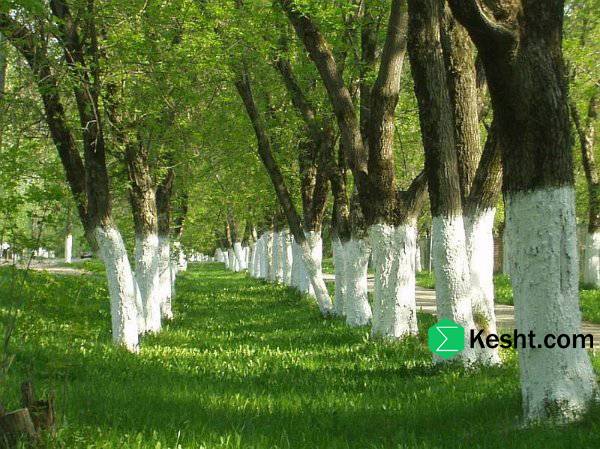
Monthly fertilization program for pistachio from planting to first bearing (years 1–5)
Assumptions
- Temperate Iranian climate (Solar Hijri calendar), drip or micro‑jet irrigation, moderately calcareous soil. If your conditions differ (e.g., flood irrigation, saline water, hotter/colder climate), tell me and I’ll tailor the plan.
- Note: Use low‑chloride K sources (K2SO4/KNO3); place P early and near roots; cut back N after mid‑summer.
Years 1–2 (establishment)
| Month (Solar Hijri) | Objective | Suggested share of annual total | Key actions |
| Esfand (late Feb–Mar) | Preparation | — | Low‑salt compost 5–10 t/ha every 1–2 years; if alkaline/sodic: elemental S/gypsum. Fe‑EDDHA in soil around emitters (5–15 g Fe active per tree). Foliar Zn + B if needed (per label). |
| Farvardin (Mar–Apr) | Gentle start of growth | N: 20% • P2O5: 40% | Begin fertigation in small splits; avoid heavy N right at budbreak. |
| Ordibehesht (Apr–May) | Active vegetative growth | N: 35% • P2O5: 40% | Continue split N; targeted foliar micronutrients only if deficiencies are present. |
| Khordad (May–Jun) | Root and canopy development | N: 30% • P2O5: 20% • K2O: 30% | Start light K (in K‑poor soils or with saline water; use low‑Cl sources). Light calcium nitrate if needed. |
| Tir (Jun–Jul) | Wrap N; boost stress tolerance | N: 15% • K2O: 40% | Taper N; raise K modestly; supply Mg if interveinal chlorosis appears on older leaves. |
| Mordad (Jul–Aug) | Tissue firmness/heat stress | N: 0–10% • K2O: 30% | Apply a little N only if foliage is actively green; focus on K and even irrigation. |
| Shahrivar (Aug–Sep) | Finish | — | Stop N; if salinity is building, run a leaching irrigation. |
Years 3–4 (canopy structure, pre‑bearing)
| Month | Objective | Suggested share of annual total | Key actions |
| Esfand | Soil fixes & micros | — | As in years 1–2; Fe‑EDDHA where chlorosis is recurrent. |
| Farvardin | Early growth | N: 20% • P2O5: 40% | Gentle N and P; foliar Zn/B if needed. |
| Ordibehesht | Peak vegetative growth | N: 30% • P2O5: 40% | Split doses via fertigation; watch EC/salinity. |
| Khordad | Start K | N: 25% • P2O5: 20% • K2O: 30% | Begin regular K; choose K2SO4/KNO3 with saline soil/water. |
| Tir | Heat stress | N: 15% • K2O: 40% | Taper N; keep K steady; Mg/Ca as needed. |
| Mordad | Complete K | N: 10% • K2O: 30% | Avoid high N; focus on tissue quality and stress tolerance. |
| Shahrivar | Wrap up | — | End fertilization; leach if needed. |
If you are interested, it is recommended that you read the following article / article title:
Choosing the best pistachio sapling
https://ekesht.com/en/blog/choosing-the-best-pistachio-sapling
Year 5 (start of light cropping)
| Month | Objective | Suggested share of annual total | Key actions |
| Esfand | Preparation | — | Organic/amendments + Fe‑EDDHA if needed. |
| Farvardin | Early growth and set | N: 20% • P2O5: 40% | Moderate N/P; avoid heavy N near bloom. |
| Ordibehesht | Stabilize growth | N: 25% • P2O5: 40% | Continue split N. |
| Khordad | Start light nut set | N: 25% • P2O5: 20% • K2O: 30% | Introduce K; if irrigation water Cl– is high, avoid KCl. |
| Tir | Early kernel fill | N: 15% • K2O: 40% | Keep K steady; taper N. |
| Mordad | Quality and firmness | N: 10% • K2O: 30% | Keep irrigation uniform; targeted micronutrients if deficiencies show. |
| Shahrivar | Finish | — | End fertilization; if leaves stay healthy, one light N after an early harvest can be considered. |
Key foliar sprays (only if needed and after a leaf test/spot test)
- Zn: Zn chelate 0.2–0.3% or zinc sulfate at safe, labeled rates in late Esfand/early Farvardin.
- B: Boric acid 0.1–0.15% pre‑bloom (narrow safety margin—do not overapply).
- Fe: For chlorosis, soil application of Fe‑EDDHA in early spring is more effective than foliar.
- Mg: Magnesium sulfate 0.5–1% in Khordad/Tir if deficiency appears.
- Notes: Keep spray solution pH 5.5–6.5; spray in cool weather; always patch‑test on a few shoots first.
Suggested fertilizer sources
- N: Urea (acidified in fertigation), calcium nitrate or CAN where sodium is low.
- P: Phosphoric acid or MAP; in calcareous soils, place near roots/band for better efficiency.
- K: K2SO4 or KNO3 (avoid KCl in most pistachio orchards).
- Amendments: Gypsum for sodic soils; elemental S for gradual pH adjustment.
Execution essentials
- Split doses across the month (especially with drip).
- Monitor water quality (EC, bicarbonate, chloride). Keep the fertigation solution’s EC rise over raw water as low as practical (ideally < ~0.5 dS/m).
- Reduce N after mid‑summer to avoid late vegetative flush and quality loss.
- In saline soils/waters, avoid KCl and consider periodic leaching irrigations.
If you are interested, it is recommended that you read the following article / article title:
Practical guide to factors affecting growth and bearing of pistachio saplings
We are the “ekesht” platform — a subsidiary of Samin Atlas Iranians and the only official exporter of BlueLabel seedlings in Iran
Why Blue Label?
Because the world only trusts these seedlings!
Ordinary seedlings (without labels or other labels), even if one of them is infected, can destroy your entire garden — without you realizing it!
But the advantage of Blue Label seedlings:
✅Each of them has a global barcode
✅Tested in advanced laboratories
✅Free from any viruses and microbes
✅The only seedlings that are allowed to be legally exported!
This is important for you if:
- You want to build a garden that is productive and hassle-free
- You are looking for a long-term investment in gardening
- You want to start without stress, without losses, without surprises!
Blue Label seedlings = peace of mind
Because when the seedlings are healthy, the garden stays healthy — and real profits come!
Contact us now — before a random seedling destroys your garden!
Healthy Seedlings = Fruitful Garden = Smart Investment
And that’s exactly what we do at ekesht.
ekesht platform (with fifteen years of practical and successful trade experience with Russia, Kazakhstan, Iraq, China, Turkmenistan, Turkey, etc.) is ready to cooperate with people active in the field of agriculture.
For more information and additional information, please contact us via social media, phone call or email
Phone number:
Email:
Social media address: